
Free tool
One-rep max calculator
Enter the weight and reps from one hard set to estimate your one-rep max (1RM). The calculator uses the Epley formula, the same one the Brolift app uses.
1 to 2,000, decimals allowed
Whole number, 1 to 30
Estimated one-rep max
263 lb
225 × (1 + 5/30) = 262.5, rounded up to 263 lb
Epley formula. As in the Rep Max Calculator in the Brolift app, the estimate is rounded up to a whole pound and a set of 1 rep returns the weight itself. In kg mode it is rounded up to a whole kilogram.
Training percentages
| % of 1RM | Reps | Weight |
|---|---|---|
| 100% | 1 | 265 lb |
| 95% | 2 | 250 lb |
| 90% | 3 to 4 | 235 lb |
| 85% | 5 to 6 | 225 lb |
| 80% | 7 to 8 | 210 lb |
| 75% | 9 to 10 | 195 lb |
| 70% | 12+ | 185 lb |
How the calculator works
The calculator uses the Epley formula, where w is the weight lifted and r is the number of reps:
1RM = w × (1 + r / 30)
Epley adds one thirtieth of the weight for each rep. Take a set of 225 lb for 5 reps:
- One thirtieth of the weight: 225 / 30 = 7.5 lb per rep.
- Five reps: 7.5 × 5 = 37.5 lb.
- Add it to the weight: 225 × (1 + 5/30) = 225 + 37.5 = 262.5 lb.
- Round up to a whole pound: 263 lb.
The Rep Max Calculator in the Brolift app rounds up the same way, so both give 263 lb for this set. In kg mode the estimate is rounded up to a whole kilogram.
A set of 1 rep returns the weight itself. A single is already a one-rep lift, so there is nothing to estimate. Without that rule, the equation would add a thirtieth of the weight and turn a 225 lb single into 232.5 lb.
Other one-rep max formulas
Epley is one of several published equations. Here is the same 225 lb × 5 set run through four of them, next to a 135 lb × 20 set. Values are before any rounding, shown to one decimal.
| Formula | 225 lb × 5 | 135 lb × 20 |
|---|---|---|
| Epleyw × (1 + r / 30) | 262.5 | 225.0 |
| Brzyckiw × 36 / (37 − r) | 253.1 | 285.9 |
| Lombardiw × r0.10 | 264.3 | 182.2 |
| O'Connerw × (1 + r / 40) | 253.1 | 202.5 |
The formulas agree closely at low reps and drift apart at high reps. For 225 lb × 5, the four results sit within about 11 lb of each other (253.1 to 264.3). For 135 lb × 20, they are more than 100 lb apart (182.2 to 285.9).
Epley and Brzycki give exactly the same answer at 10 reps (225 lb × 10 comes out at 300 lb with both). Below 10 reps Brzycki gives the lower estimate, above 10 the higher one.
All of these are approximations. Brolift uses Epley in the app, so this calculator does too.
Accuracy of an estimated 1RM
An estimated 1RM is a prediction from a set you did, not a tested max. Your real single on a given day can be higher or lower.
- Use sets of 10 reps or fewer. Past that the formulas spread out quickly, as the 20-rep column above shows, so a high-rep set says less about your single.
- Use a hard set. The formulas assume you did about as many reps as you could with that weight. A set stopped with several reps left gives a lower estimate.
- Reps are capped at 30, as in the Rep Max Calculator in the app. A set of more than 30 reps is counted as 30.
If you test a true max, use a spotter or set the safety arms of the rack.
Using the percentage table
Many training programs write working weights as a percentage of your 1RM, for example 3 sets of 5 at 80%. The table turns those percentages into weights you can load, rounded to the nearest 5 lb (2.5 kg in kg mode). The rows are the ones the Brolift app shows, with a 100% row added.
The reps column pairs each percentage with a typical rep range for that load. As a rule of thumb, 85% of your 1RM is a 5 to 6 rep weight, 80% is 7 to 8 reps and 75% is 9 to 10 reps. To pick a weight for a rep target, find the row with those reps. That weight is close to your limit for that many reps, so for sets you want to finish with reps to spare, go a row or two lighter.
Your max moves as you train. Run the calculator again every few weeks with a recent hard set so the percentages stay current.
Track your estimated 1RM automatically
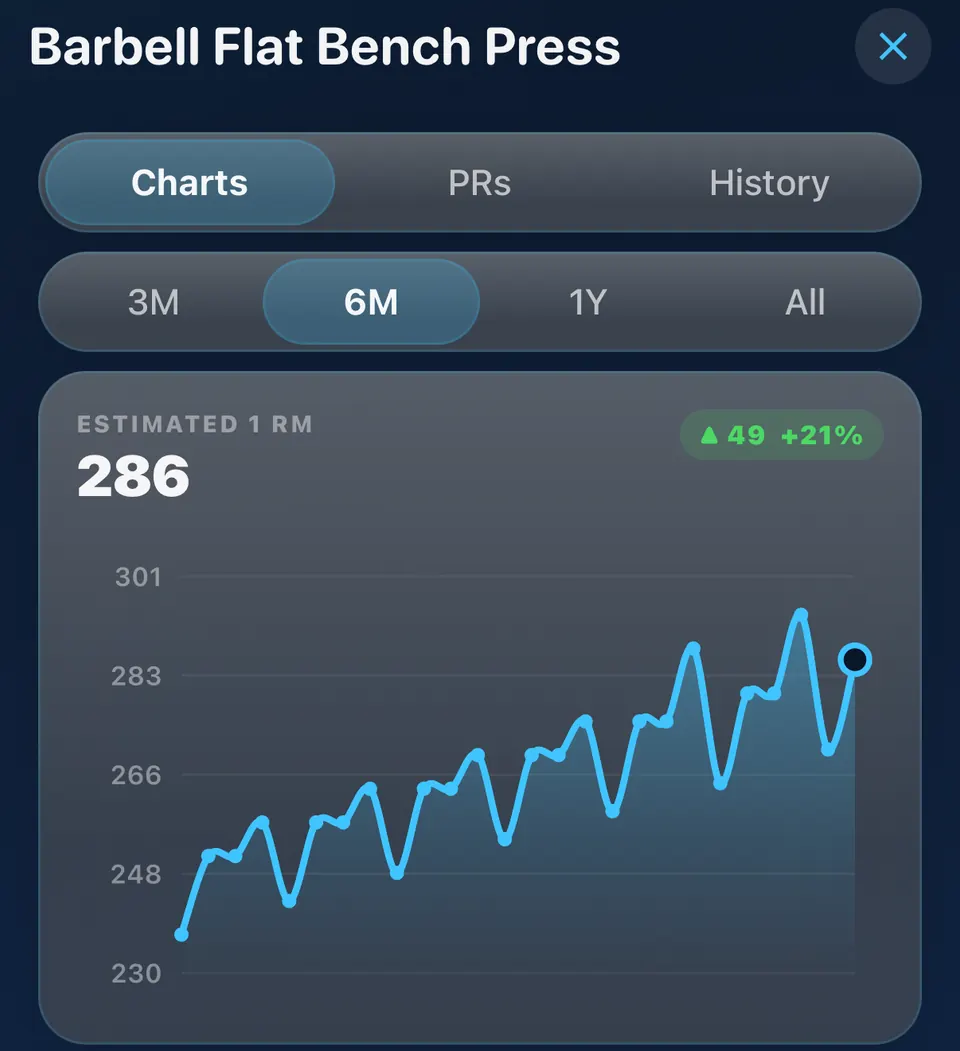
Brolift is a free workout log for iPhone. You log sets, reps and weight as you lift, and it charts an estimated 1RM and your max weight for every weighted exercise, over 3 months, 6 months, a year or all time (3M, 6M, 1Y and All).
The Estimated 1 RM chart uses the Epley formula too, plotting the best estimate from each workout's sets. The tracker also shows the reps you need for a new PR at the weight on the steppers, before you lift.
The app has a Rep Max Calculator as well, in pounds. Turn on Powerlifting mode in Settings › Preferences › Powerlifting (shown only in Detailed mode), then open Settings › Power Lifting › Rep Max Calculator.
There are no in-app purchases or ads. Brolift needs an iPhone with iOS 26 or later.
One-rep max questions
What is a one-rep max?
Your one-rep max (1RM) is the heaviest weight you can lift for one full rep of an exercise with good form. An estimated 1RM predicts that number from a set of several reps, so you do not have to test a true single to know roughly where you stand.
How do I calculate my one-rep max?
Multiply the weight by 1 + reps ÷ 30 (the Epley formula). For 225 lb × 5 reps: 225 × (1 + 5/30) = 262.5, so about 263 lb. Use a hard set of 10 reps or fewer for the closest estimate.
Which formula does Brolift use?
Brolift uses the Epley formula: weight × (1 + reps / 30), rounded up to a whole pound. The Estimated 1 RM charts use it, and so does the Rep Max Calculator, which returns the weight itself for a set of 1 and accepts up to 30 reps. This page follows the Rep Max Calculator's rules.
Does the calculator work in kilograms?
Yes. Switch the unit to kg. The formula is the same in any unit; in kg mode the estimate is rounded up to a whole kilogram and the percentage table to the nearest 2.5 kg. The Brolift app itself logs weights in pounds only.
How many reps give the best estimate?
Use a set of 10 reps or fewer, taken close to failure. The fewer the reps, the less the formula has to extrapolate: Epley adds 10% to the weight at 3 reps and a third at 10 reps. Past 10 reps the formulas disagree more and more. Like the app, this calculator accepts up to 30 reps.
Why does 1 rep return the same weight?
A set of 1 is already a one-rep lift, so there is nothing to estimate. The calculator returns the weight you entered, as the Rep Max Calculator in the Brolift app does. Running the Epley equation on 1 rep would add a thirtieth of the weight and turn a 225 lb single into 232.5 lb.
Is the percentage table rounded?
Yes. Each weight is rounded to the nearest 5 lb, as in the Brolift app, or to the nearest 2.5 kg in kg mode. That is why the 100% row can differ slightly from the estimate: an estimate of 263 lb shows as 265 lb in the table.